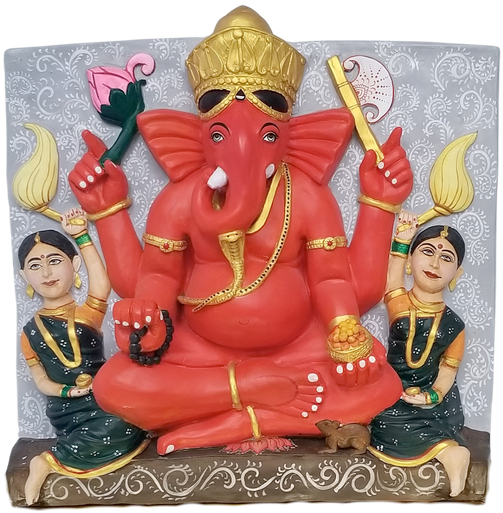
Shri Siddhi Vinayak Ji, the sacred form of Ganesh Ji in Mumbai, is revered as the remover of obstacles and the giver of wisdom and success. Devotees from all walks of life visit his temple with prayers for clarity, prosperity, and divine blessings.
With his right-curved trunk and radiant presence, Siddhi Vinayak Ji symbolizes auspicious beginnings and spiritual strength. His temple stands as a beacon of faith, drawing millions who seek guidance and grace.
In Sanatan Dharma, Shri Siddhi Vinayak Ji is more than a deity—he is a compassionate guide, a source of inner peace, and a divine force who leads the soul toward fulfillment and truth.
The Shri Siddhivinayak Temple in Mumbai is one of India's most prominent and revered Hindu temples, primarily known for granting the wishes of its devotees, earning it the moniker "Navasacha Ganapati" in Marathi.
History
The history of the temple dates back to the early 19th century:
- Construction (1801) - The original, small 3.6m x 3.6m brick structure was built on November 19, 1801, by a contractor named Laxman Vithu Patil.
- Funding and Purpose - The temple’s construction was generously supported by Deubai Patil, a devoted Agri woman. Having no children of her own, she wished to create a sacred place where devotees could seek Lord Ganesha’s blessings for fertility and family well-being.
- Expansion and Renovation - The temple's fame grew over the years, attracting a large number of devotees, including celebrities and political figures. In the 1990s, the temple underwent significant renovation and expansion, transforming it into the current magnificent structure.
Unique Features and Significance
The temple holds several unique characteristics and deep spiritual significance:
- Right-Sided Trunk In most Ganesha idols, the trunk is curved towards the left. However, in the Siddhivinayak idol, the trunk is inclined towards the right. Idols with a right-sided trunk are considered extremely powerful and associated with Siddhi Peeth, requiring stricter adherence to rituals.
- The Idol The central idol is carved from a single black stone and depicts Lord Ganesha with four hands (Chaturbhuj). In his hands, he holds a lotus, an axe, a plate of modaks (sweet dumplings), and a string of prayer beads (japamala).
- Deities Riddhi and Siddhi The idol is flanked by images of Riddhi and Siddhi, the consorts of Ganesha, symbolizing prosperity and success.
- The Mushak (Mouse) Statues The temple premises feature two silver statues of mice. Devotees believe that whispering their wishes into the ears of these mice conveys their prayers directly to Lord Ganesha.
- The Mandar Tree Prophecy According to local legend, a Hindu saint, Akkalkot Swami Samarth, instructed that two idols be buried in front of the main deity. He prophesied that a Mandar tree would grow at that spot with a Svayambhu (self-manifested) image of Ganesha in its branches after 21 years, which came true.
The temple is managed by the Shree Siddhivinayak Ganapati Mandir Trust, which uses its income for various charitable and social welfare activities.